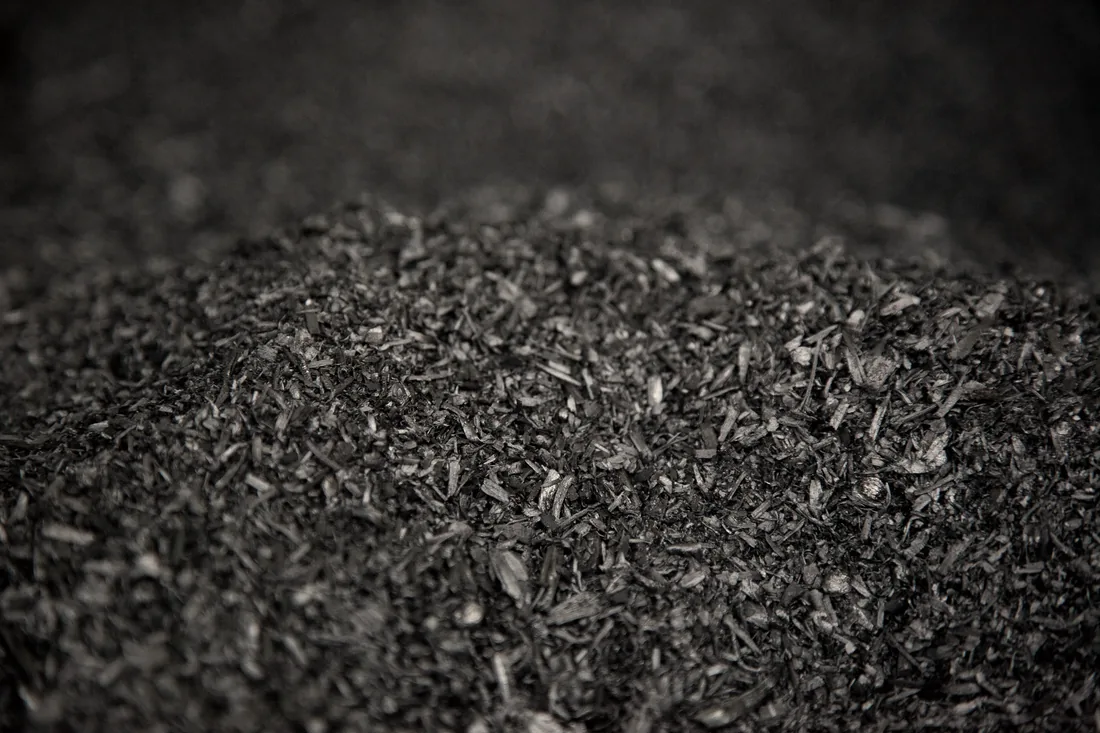
What it is
Biochar is biomass burned in the near-absence of oxygen — pyrolysis — until what remains is mostly carbon and almost nothing else. It is not ash, and it is not compost. What makes it useful is its structure: a single gram has an internal surface area of several hundred square metres, all of it riddled with pores the size of the bacteria and fungi that soil depends on.
Buried, it holds water, adsorbs nutrients that would otherwise leach, and provides a refuge where soil life survives drought and tillage. The carbon in it is stable for centuries, which is why it is also one of the few carbon-removal methods a small farm can practise at home.
How we make it
We use a top-lit updraft barrel, the simplest credible design: a smaller drum inside a larger one, feedstock packed into the annulus, a fire lit on top of the fuel and allowed to burn downward against an updraft. The wood gas re-burns in the gap, which is why the smoke is thin and blue rather than black.
Feedstock is whatever the parcel gives us — conifer slash, alder from the thinning, blackberry cane dried over a summer. It is chipped, dried to under twenty percent moisture, and pyrolysed in batches of about forty litres at a time.
Charging it
Raw biochar is a sponge that will pull nutrients out of soil before it gives them back. Ours is charged before it goes out: soaked in urine, steeped in compost extract, or layered into the chicken bedding for a season. Only charged char goes into the pasture.
Application is light — a few tonnes per hectare at most, worked into the top few inches. This is not a product you spread by the truckload.